


WBC’s head classifier was instrumental in developing the classification modules for the learning hub
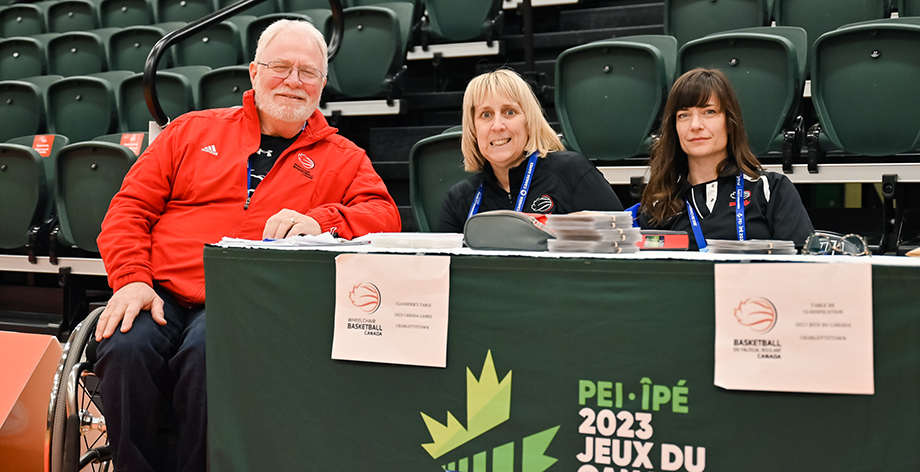
Karen Ferguson, an occupational therapist by trade, relocated from Dartmouth, N.S., to Saint John, N.B., in search of work when she inadvertently discovered wheelchair basketball.
Ferguson grew up in Nova Scotia and completed her schooling in the province, but when it came to finding work, she was forced to relocate.
Looking to get more involved in her new community, Ferguson discovered adaptive sports.
“We used to get a hard copy newsletter that would come to each of us a couple of times a year. One of them had a little article about a junior wheelchair basketball program that was running in Saint John,” Ferguson explained. “I thought, ‘That’s pretty cool, that interests me.’ I called them to see if they needed volunteers, and they said, ‘Sure.’
“I went, and two weeks later, they’re like, ‘Do you want to try it yourself?’ I was like, ‘Sure.’ A couple of nights later, I was at practice, and a month later, I was playing in my first tournament. I managed the New Brunswick Canada Games team in 1999, 2003, and 2007. Wheelchair basketball just took over and became a huge part of my life.”
While managing Team NB’s wheelchair basketball team, Ferguson met Anne Lachance. At the time, Lachance was WBC’s head classifier.
“She asked me if I wanted to learn about classification, so we spent a couple of hours together and she taught me about the classification system,” Ferguson recalled. “About a month later, I went to my first tournament, and the rest is history.”
Today, Ferguson is head classifier for Wheelchair Basketball Canada, a role she’s held since 2015. She has also been an international classifier with the International Wheelchair Basketball Federation since 2009.
Developing the classification modules for WBC’s Learning Hub
Using their expertise as classifiers, Ferguson and Lachance helped develop the classification modules and seating guidelines for specific classes as part of WBC’s new Learning Hub launched in February 2025.
The learning hub is designed to support the development of grassroots programs. Also, it provides those looking to learn, teach or enjoy wheelchair basketball with the tools, knowledge, and resources to elevate their game.
The learning hub includes training modules, instructional videos, and best practices tailored specifically for wheelchair basketball.
“We have felt that it would be beneficial to have some classification modules,” Ferguson said. “Initially, it was for coaches because we thought coaches often came to us not understanding what we do with classification or how they should propose classes for their athletes.
“As we put it together, we felt that it would be beneficial to anybody and not just to the coaches. Athletes could look at it and see what we’re looking at, what the different classes are, the characteristics of the classes and what different athletes can do based on their class.”
In addition to the modules, the learning hub includes a resources section where Ferguson helped develop seating guidelines for the classifications.
“We see a lot of athletes that come to tournaments that are in club chairs, and they may not be in the chair that’s best for them,” said Ferguson. “The guidelines include the best way to position the athlete or how to position an athlete to get the most function and the most stable and all those kinds of considerations.”
The seating guidelines can be useful for athletes looking for advice. The guidelines also provide coaches with information on how to position a new athlete and how to pick the right chair.
“It could be for an athlete who’s trying to set their chair up better, or a coach who’s newer to the sport, who doesn’t know a lot about wheelchair setup, who might be trying to maximize their athlete’s ability,” said Ferguson.
The learning hub includes 34 instructional videos, 50 practice plans, seven classification modules, six seating guidelines and five table official modules.
Ferguson hopes the classification modules will help everyone involved better understand the process of classifying an athlete.
“Athletes, coaches, parents – anybody who might be questioning what it is we look at when we classify an athlete,” she said. “The different things we look at, the distinct characteristics of each class, how we consider upper extremity or how we classify the amputees – any of those other things.
“It would be a good tool for individuals to understand what classification is and how it impacts the game.”