


The Vancouver native will be formally inducted during a ceremony at the National Championships
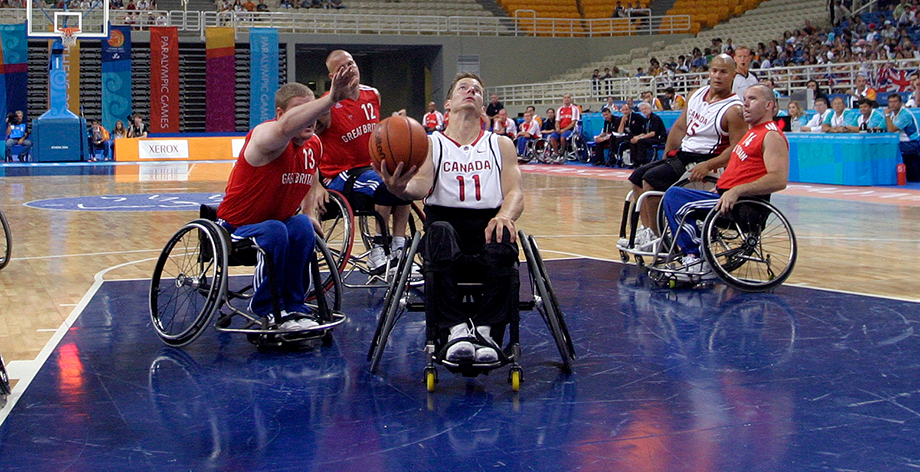
Jaimie Borisoff’s legacy in wheelchair basketball is built on excellence, longevity, and an enduring commitment to community—both on and off the court. As the Vancouver, B.C., native enters the Wheelchair Basketball Canada Hall of Fame, he’s reflecting on his career on the court and the relationships and shared experiences off the court.
“It’s such a good group of folks already in there, and it’s an honour to join them,” Borisoff said. “I’m pretty proud of this.”
A mainstay on the Senior Men’s National Team for over a decade, Borisoff enters the hall with a well-decorated resume — a two-time Paralympic gold medallist in Sydney 2000 and Athens 2004, he added a silver medal at the 2008 Beijing Games, capping a run of three consecutive podium finishes. Across four Paralympic appearances, beginning with Atlanta 1996, he evolved from a newcomer logging heavy minutes into a veteran leader anchoring one of the world’s top programs.
“I think you do reflect on your career,” he said. “The competition moments in terms of the big wins with Canada in particular, like Sydney—the first gold medal in 2000. All the Paralympics were great in their own way.”
Those defining victories were complemented by success on the world stage. Borisoff helped Canada capture gold at the 2006 IWBF World Championships in Amsterdam, while also earning bronze medals in 1998 and 2002. His performance at the 1998 Worlds earned him a place on the tournament’s All-Star Five.
Despite the accolades, Borisoff resists narrowing his career to medals alone.
“The people,” he said when asked what he misses most about the game. “You hear that from, I think, everybody—the people you meet along the way and the friendships you make… lifelong friends.”
He recalls the quieter, less visible moments with as much clarity as the podium finishes—time spent travelling, sharing meals, and building connections that extended far beyond competition.
“I probably have more memories almost of the interactions with people, not on the court but in the hotel, in the city, and the travelling around on the bus or train,” he said. “All those kinds of interactions where you’re just hanging out with people and getting to know them and having a great time.”
Those bonds were forged within a uniquely strong development environment in B.C., where Borisoff honed his craft alongside a deep pool of talent and mentorship.
Under the guidance of coaches Tim Frick and Joe Higgins, and alongside teammates who would go on to shape the national program, he developed in a system that emphasized both technical excellence and collective growth.
“I’m pretty lucky being in Vancouver at the time,” he said. “All I had to do was show up in the gym, and they had everything structured. They had recruited people and players. We had such a great nucleus of people.”
That environment extended beyond coaching, drawing from previous generations of athletes who helped elevate the standard.
“So much of what you learn as a player, you learn from your peers, your teammates,” Borisoff said. “It was just such a great environment we had to learn the game.”
Domestically, that foundation translated into sustained success. Borisoff captured eight Canadian titles with Team BC, earned 11 Nationals All-Star selections, and added five Canadian Wheelchair Basketball League championships with Douglas College. He also claimed an NWBA Division 1 title with the Cable Cars, further underscoring his consistency across leagues and levels.
His impact was immediate and enduring. At his first Paralympic Games in Atlanta, Borisoff led Canada in minutes played—a reflection of both his readiness and the trust placed in him. Over the next 15 years, he remained a central figure in the program, adapting his role while maintaining a high standard of performance.
Off the court, Borisoff continues to shape the future of accessibility and sport through his work in applied research. As the director of the MAKE+ Applied Research Team at the British Columbia Institute of Technology, he leads initiatives to develop assistive technologies, including advancements in wheelchair design and adaptive equipment.
“Trying to make better wheelchairs and better exercise equipment and better assistive technology for people with disabilities and older adults,” he said.