


A historic double gold in Sun City, South Africa crowned Team Canada’s men’s and women’s teams as the first-ever world champions in 3×3 wheelchair basketball
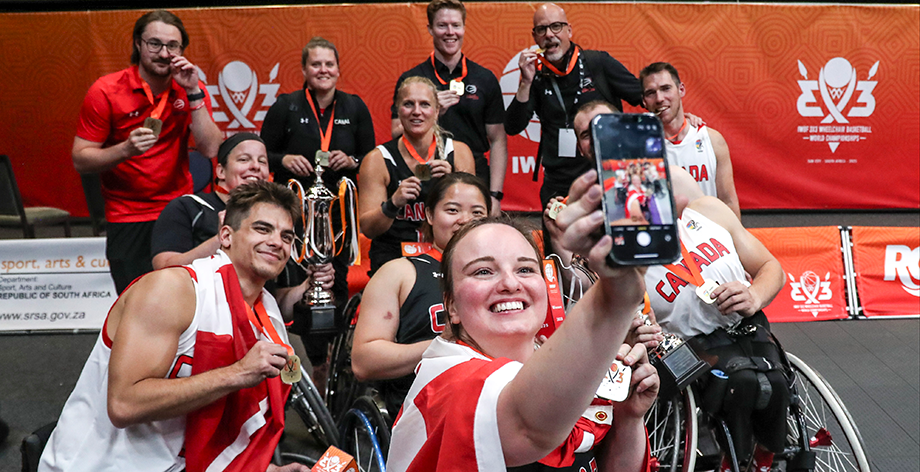
Canada’s men’s and women’s teams etched their names in the record books in 2025 claiming double gold at the inaugural IWBF 3×3 Open World Championships – a moment that will be commemorated with an induction into the Wheelchair Basketball Canada Hall of Fame.
For Canada, it was an opportunity to build on the success at the 2022 Commonwealth Games, where the women captured gold and the men earned silver.
“It was very cool. It was the first 3×3 Worlds,” said men’s tournament MVP Colin Higgins. “To kind of break that barrier, see what it’s like, play against some teams in a format we haven’t had a lot of experience before in, and then to come away with gold was a really special experience.”
A Perfect Run
Canada’s women set the tone early — and never let it slip.
With Kady Dandeneau leading the way as tournament MVP and Élodie Tessier earning All-Star honours, the Canadian squad delivered a composed and commanding performance throughout the competition.
Puisand Lai and Tamara Steeves rounded out the women’s roster than went on an undefeated run culminating in a 17–12 victory over Spain in the final, a game that reflected both their consistency and their control.
Earlier that day, Canada secured its place in the championship game with a 15–10 semifinal win over Great Britain.
“To have the double gold, that was awesome,” said Dandeneau. “I think any athlete is a pretty big fan of winning. Gold medal games are great, but it’s cool to be the first ever gold medalists in 3×3 wheelchair basketball. A neat little notch on the resume.”
While winning gold was the goal, developing the game was also important for the Pender Island, B.C. native.
“It’s also about growing our sport and pioneering the start of this 3×3,” she said. “I love 3×3. I think it’s incredibly fun, but it was also important to be involved in it to help it grow, to help it set some roots.”
That sense of responsibility — to compete, but also to contribute — underscored the broader impact of the event.
“I think that’s the coolest part about 3×3,” Dandeneau added. “It’s a lot more accessible for developing programs.
“You help developing countries progress and then having the great competition that comes with top calibre countries competing.”
Resilience on Display
On the men’s side, Canada opened the tournament with tight, hard-fought contests and suffered a setback in pool play, falling 18–12 to Spain.
“Most of the tournament we were grinding out one or two point wins,” Higgins said. “Then we had lost to Spain earlier, so to beat them in the final was pretty special.”
Lee Melymick, Garrett Ostepchuk and Vincent Dallaire rounded out the men’s roster.
In the semifinals, Canada edged Austria 13–12 in a tense showdown — a rematch of their tournament opener that had already required overtime to decide.
That narrow victory set up a second meeting with Spain, where Canada delivered its most complete performance of the tournament, securing a 14–9 win to claim gold.
“The girls had won their gold earlier in the day,” Higgins said. “We were trying to match that energy and so to share that spotlight with them in that moment was pretty neat.”
For both teams, the championships represented more than competitive success. They were a milestone in personal and national journeys alike.
“Representing Canada always, whenever you can do something with Canada across your chest, it’s always going to be special,” Dandeneau said. “It was cool to win, but the opportunity to represent Canada is an honour.”
For Higgins, the victory carried similar weight.
“Something I hadn’t done before,” he said. “To kind of see it all come together over a weekend was quite rewarding.”