


A fibrous dysplasia diagnosis forced the Summerside native to pivot to wheelchair basketball — now he’s helping guide the next generation
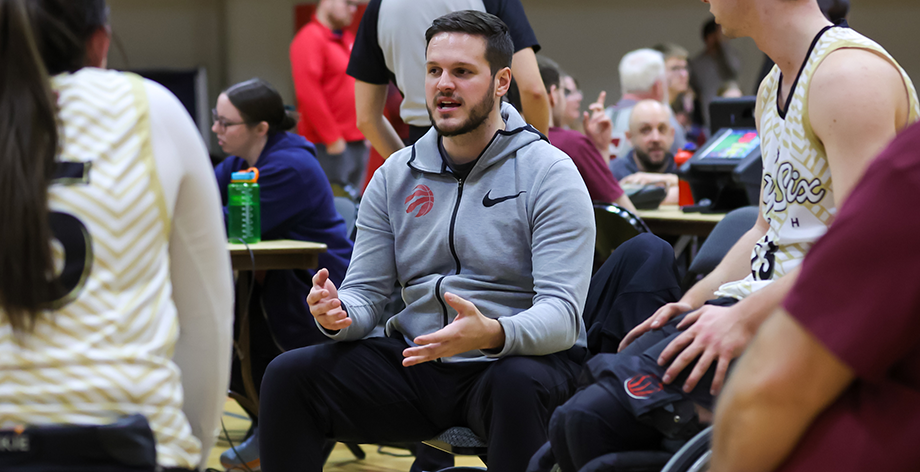
For Westley Johnston, basketball has always been more than a game. It’s been a constant through injury, reinvention, and now his transition to coaching.
Johnston first discovered wheelchair basketball after a difficult stretch in his teenage years.
A femur injury forced him to step away from hockey in 2008, leading Johnston to play stand-up basketball.
Doctors eventually diagnosed the Summerside, P.E.I. native with fibrous dysplasia, a disorder where healthy bone is replaced by scar tissue.
“The injury never healed correctly,” Johnston recalled. “We found out that I had a disorder called fibrous dysplasia — basically, your healthy bone is replaced by scar tissue.”
The diagnosis led to major reconstructive surgery. Surgeons removed the affected bone tissue, replacing it with cadaver bone and stabilizing his leg with rods and pins. The disorder and resulting surgery ended Johnston’s ability to compete in able-bodied sports.
“It was like a year-long recovery,” he said. “At that age, a 15-year-old kid, losing sports is a pretty big deal.”
Johnston suddenly found himself searching for a new outlet.
His introduction to wheelchair basketball came in an unlikely way — watching television with his family.
“We were watching the Rick Mercer Report back in 2011, and he did a segment with Wheelchair Basketball Canada,” Johnston said. “My mom was like, ‘Hey, what about that? You love basketball, what about this?’”
The segment on the Rick Mercer Report changed everything for Johnston’s athletic career.
Seeing athletes like Dave Durepos shooting three-pointers convinced Johnston that the game he loved was still within reach.
“When I saw the Rick Mercer show and Dave shooting threes with his eyes closed, I realized I’m not going to lose what I loved,” he said.
Johnston quickly found playing options with the PEI Colts, and what began as a new activity quickly turned into something more serious.
“Basketball is something that I had success at really quickly,” he said. “There’s just something about basketball that I’ve always loved. Being alone in a gym and shooting a ball for hours on end — that was something I always loved doing.
“When I had my diagnosis, I didn’t want to lose that.”
As Johnston continued developing his game, he wasn’t initially sure he could pursue the sport at a high-performance level. That changed when a meeting with classifier Karen Ferguson revealed his diagnosis made him a classifiable athlete.
“That was kind of the first introduction that there is a high-performance avenue for wheelchair basketball,” he said.
For Johnston, the possibility of representing Canada was instantly motivating. Growing up, he had always been captivated by the Olympic Games.
“I was in love with the Olympics,” he said. “You watch the Beijing Olympics and all those athletes, you watch the Vancouver Olympics and Sidney Crosby and the golden goal — all that stuff, the red and white. That was my obsession growing up.”
Discovering that wheelchair basketball had its own pathway to represent Canada — including the Paralympics — sparked a new ambition.
“Every kid growing up, for me it was always like Team Canada was the dream,” he said.
Johnston’s first true measuring stick of where his game was at came in 2015 at the Canada Games with Team PEI. His development continued through the Junior National Program, leading him to move to Toronto in preparation for the 2017 Men’s U23 World Wheelchair Basketball Championship.
The opportunity to represent Canada on home soil was one the 30-year-old won’t soon forget.
“Having everyone come and rally around you was really cool,” Johnston said. “It’s still one of those amazing things where all your friends and family can fly up and see you. It’s exciting to have your family around for the buzz of Junior Worlds and be there, part of that experience for you.”
With Ottawa set to host the 2026 IWBF Wheelchair Basketball World Championships, and Team Canada getting an opportunity to represent on home soil once again, Johnston’s message for the athletes is simple.
“Enjoy the moment with your friends and families, being around in the buzz,” he said. “When you’re at home, you get to experience all that with your loved ones, which is, you know, even more special.”
The Junior Worlds experience also helped Johnston sell his family on his relocating full-time to the National Academy. Upon graduating from the University of Prince Edward Island with a major in sociology and a minor in philosophy, Johnston relocated to the National Academy in 2019.
The experience with Team Canada opened new doors, including international competition.
One of the highlights of his playing career came in 2022 when he competed professionally in Spain — an experience he describes as both challenging and unforgettable.
“In terms of playing in a different country, it was one of the cooler things I’ve ever done,” Johnston said.
Unlike the tournament-style schedule common in Canada, the European league structure meant preparing for games every week.
“Every week you’re preparing for someone different,” he said. “Everything that led up to gameday is impactful — your sleep, your rest, your nutrition, your training.”
Living overseas also pushed Johnston out of his comfort zone.
“Lots of interesting challenges of not being able to speak the language with your teammates and your coaches,” he said. “Learning how to communicate without communicating was one of those things. Being able to do that is a chip on my shoulder now.”
Today, Johnston’s focus has shifted from competing to guiding others.
The transition into coaching came gradually and almost accidentally.
“Coaching was not really something that I even considered,” he admitted. “The ignorance of being an athlete is, ‘I’m an athlete — never be a coach.’”
But while completing a sport and recreation degree at the University of New Brunswick, Johnston began helping teammates during club practices. Suggesting drills and sharing knowledge eventually turned into something more structured.
“That was just kind of the way it started,” he said.
Soon, Johnston found himself taking on a bigger leadership role, helping elevate the program and mentoring younger players.
His coaching journey has continued to grow. Johnston will serve as coach for Team New Brunswick at the upcoming Junior National Championships in Quebec City, guiding athletes through a major milestone in their development.
For him, it’s a full-circle moment.
“When deciding to retire from full-time training, my goal was to still be involved in sport,” Johnston said. “Now head coaching the junior provincial team — that’s something I wanted to do. It’s all full-circle moments.”
Off the court, Johnston works as a program coordinator for KidSport New Brunswick, helping families access sport opportunities by providing financial support for registration and equipment.
The role reflects the same philosophy he brings to coaching — that sport can change lives.
One of Johnston’s biggest coaching influences is Michael Frogley, whose approach continues to shape Johnston’s own coaching style.
“He was really impactful in my developmental journey,” Johnston said. “His holistic approach to coaching and things like that is really impactful in the things that I try to teach my athletes, too.”
For Johnston, the lessons learned through sport extend far beyond the scoreboard.
“Sport is a way for athletes to learn life skills outside of their lives,” he said. “It’s like an echo chamber for learning really tough life skills really quickly.”
Those lessons — resilience, teamwork, and perseverance — are the same ones Johnston now hopes to pass on to the next generation.
And while he may have stepped away from full-time training, he hasn’t completely left the court.
“I still get in the chair every Tuesday, Thursday,” he said with a laugh.