


From national titles to grassroots innovation, the 1980s Alberta Northern Lights helped define an era of excellence while laying the foundation for the future of wheelchair basketball in Canada
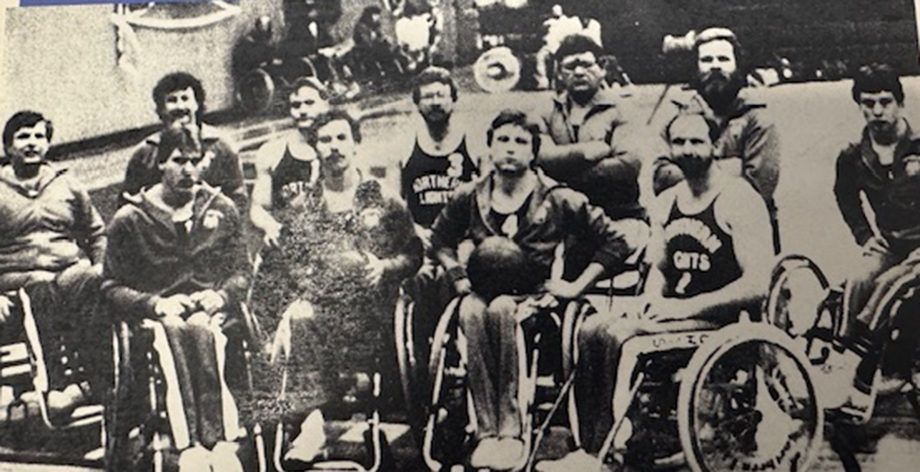
In the landscape of Canadian wheelchair basketball, few teams have left a mark as enduring—or as influential—as the 1980s Alberta Northern Lights. Now, as they take their place in the Wheelchair Basketball Canada Hall of Fame, their story stands as a blueprint for excellence, innovation, and community impact.
At their peak, the Northern Lights were more than just a dominant team—they were a standard. Competing across Canada and the United States, they consistently ranked among the top programs.
“A great group of people back then,” recalled Ron Minor, who serves as Vice President of the Board of Directors for the Alberta Northern Lights. “We were one of the top teams in Canada and one of the top teams in the U.S.”
The Northern Lights emerged from a strong basketball culture in Alberta, particularly in communities where the sport was deeply embedded. For many players, including Minor, the transition into wheelchair basketball was a continuation of that tradition.
“I think Alberta has a history of great basketball… The whole area was a big basketball area. That’s kind of where I grew up from,” said Minor, inducted into the Edmonton Sports Hall of Fame in 2018. “I moved to Edmonton, and Edmonton was, at that point, the focal point for wheelchair basketball.”
By the early 1980s, the Northern Lights had assembled a roster that would become the envy of the sport. At one point, their starting lineup mirrored the Canadian national team.
“I knew we had something going because at one time, our starters were all on the Canadian team,” Minor said. “So you knew that you had something special.”
That “something special” translated into results. After years of near-misses, including multiple second-place finishes, the breakthrough finally came in 1983 with a national championship victory over the Vancouver Cable Cars—a dominant team in that era.
“They were all special,” Minor said of the championships. “The first one was really special because that was in 1983… we had finished second three or four times in a row. Then we finally came through and managed to win.”
But the Northern Lights’ legacy extends far beyond trophies.
The team helped pioneer the Challenge Cup. Designed to bring together the top teams in the National Wheelchair Basketball Association (NWBA), the competition raised the standard of play while introducing high-level wheelchair basketball to Canadian audiences.
“That was really cool because the Challenge Cup… got together the 10 top teams in the NWBA,” Minor explained. “We had one tournament a year where these 10 teams would come to play, and it was a big competition.”
More importantly, it brought the game home.
“For a long time, we didn’t play hardly any games in Edmonton,” he said. “The Challenge Cup brought the wheelchair basketball to Edmonton.”
The impact of those crowds—and the visibility they created—helped grow the sport in ways that are still felt today. Media coverage, community engagement, and outreach became hallmarks of the program.
Among the most enduring contributions was the development of grassroots initiatives, including school programs, junior camps, and city leagues. What began as a simple awareness effort evolved into a cornerstone of the organization’s identity.
“Originally, what would happen is that we would send some chairs to a school and we would allow them to practice in the chairs for a week,” Minor explained. “Then we would go and take the team, and we would go and play them… just as an awareness opportunity.”
Today, the program has grown into a structured and in-demand initiative, with equipment constantly in circulation in local schools.
“We have a waiting list for chairs,” Minor added. “There’s not a week during the school year that they’re not at a school somewhere.”
That pipeline—from grassroots exposure to elite competition—has remained central to the Northern Lights’ success. Decades later, the program continues to produce national team athletes and foster new generations of players.
“It’s a good problem to have,” Minor said of the program’s recent growth. “When you have 20 or more people in a practice… but it means there are people who are going to be looked at on the Canadian team.”
As the Alberta Northern Lights approach their 50th anniversary, their induction into the Hall of Fame is both a celebration and a recognition long overdue. Built on vision, sustained by community, and defined by excellence, the teams of the 1980s didn’t just compete—they transformed the sport.
“It is very special,” Minor said. “To be considered one of the more dominant clubs in the history of wheelchair basketball in Canada.”